High-Nit Anti-Glare Outdoor Screens
Nothing ruins an afternoon fixture faster than a washed-out screen where bright midday sun turns the pitch into an unreadable mirror. Understanding outdoor screen engineering ensures you never suffer blinding glare again.
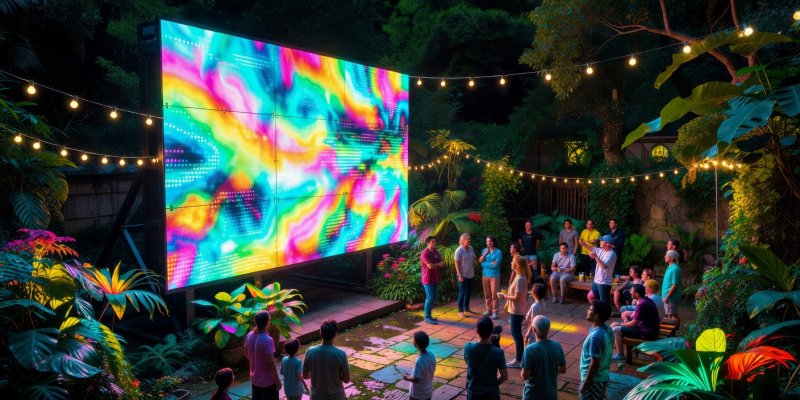
The Science of Luminance: Why Indoor TVs Fail
Standard household flat screens produce between 250 and 400 nits (candelas per square meter) of brightness. On an overcast afternoon, ambient outdoor light typically measures 2,000 to 4,000 nits; under direct midday sunlight, illumination can skyrocket beyond 10,000 nits.
When an ordinary TV is mounted under a basic outdoor pergola, the reflection of the sky easily overpowers the panel's backlight. The human eye perceives only washed-out silhouettes, making it nearly impossible to follow the ball or read on-screen match timing clocks.
Comparing Outdoor Screen Categories
| Feature | Weatherproof TV | Commercial High-Bright | Direct-View LED Wall |
|---|---|---|---|
| Typical Luminance | 1,000 – 1,500 Nits | 2,500 – 3,500 Nits | 5,000 – 8,000+ Nits |
| Direct Sun Readiness | Partial shade only | Good with hood visor | Flawless in full midday sun |
| Panel Finish | Semi-gloss coating | Matte anti-reflective | Louvered black LED matrix |
| Viewing Angle | Degrades past 45° | Moderate (60°) | Ultra-wide (160° horizontal) |
Optical Bonding & Micro-Louvers
Premium venue screens employ two critical hardware techniques: optical bonding and micro-louvers. Optical bonding injects an optically clear resin between the protective glass and the display panel, eliminating the microscopic air gap that causes internal light refraction and mirror ghosting.
Direct-view outdoor LED panels go one step further by incorporating molded black louvers above each surface-mounted diode (SMD). These tiny horizontal visors cast microscopic shadows across the black panel face, preventing the sun overhead from washing out contrast while directing crisp video photons straight to the supporters seated below.
Checking a Venue's Setup Before Kick-Off
When scouting outdoor bars for major tournament matches, ask venue staff where their outdoor displays face. A screen that faces directly east will struggle during lunchtime kick-offs, while a west-facing screen faces severe blinding glare during late afternoon summer matches. North-facing screens with overhead canopies provide the most consistent contrast throughout the day.